


- Products
- News & Events
- Successful Cases
- Client Visit


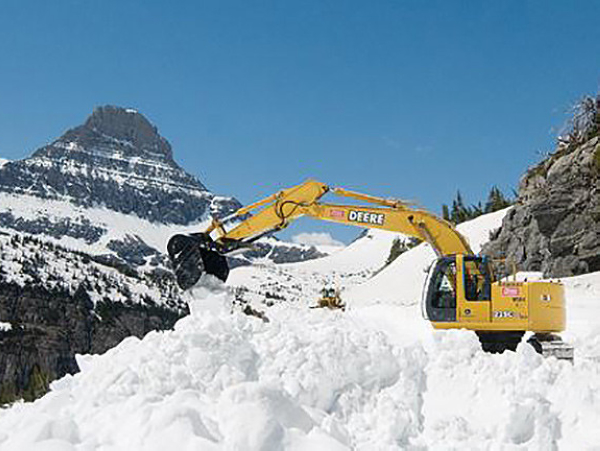
When operating in high-altitude, frigid environments to excavate mountains and construct roads, construction machinery frequently encounters the challenge of difficult starting. Today we shall discuss: why does starting prove difficult in high-altitude, frigid conditions? What corresponding solutions exist?
Diesel engines operate on the compression ignition principle, requiring specific conditions for successful start-up:
(1) Exceeding a minimum rotational speed during ignition.
(2) Achieving sufficient pressure in the combustion chamber at the end of the compression stroke to ignite the fuel-air mixture.
(3) Ensuring adequate temperature within the cylinder mixture at the end of compression.
(4) Maintaining a minimum oxygen concentration within the compressed air.
Why do high-altitude, low-temperature conditions hinder engine start-up?
1. At high altitudes, atmospheric pressure is lower, and winter temperatures are significantly colder than in lowland areas—typically 20-30 degrees lower, with extreme temperatures around -40°C. This results in reduced intake air temperature and pressure, preventing the mixture from reaching the required temperature and pressure for compression ignition by the end of the compression stroke. Consequently, engine starting becomes extremely difficult.
2. Oxygen content in the air diminishes with increasing altitude. Above 3,000 metres, atmospheric oxygen levels drop to 60-70% of those at sea level. When the oxygen concentration in the intake mixture becomes too low, diesel engine starting becomes problematic.
3. At high altitudes and low temperatures, the output capacity of the battery diminishes. This limits the starting motor's power output, resulting in insufficient cranking speed for the diesel engine, further hindering starting.
4. At low temperatures, engine oil viscosity increases, raising friction resistance within engine components and further reducing the diesel engine's starting speed.
5. In cold conditions, diesel fuel viscosity rises, impairing fuel atomisation. Lower-grade diesel may also solidify or form wax deposits, further hindering ignition.
How to enhance diesel engine starting capability?
(1) Employ batteries with low-temperature resistance technology and implement battery heating/insulation to ensure normal charge/discharge functionality in cold conditions, thereby improving cold-start performance. Crucially, when insulating/heating batteries, ensure they are in good technical condition and maintain the electrolyte level within specified limits. Excessively low levels may cause heating to become uncontrolled. It is particularly important that the temperature sensor remains connected; removal will also lead to uncontrolled heating.
(2) Lower the ignition temperature of the fuel-air mixture, such as by employing ether to assist cold starts. Ether has an ignition temperature of merely 57°C at 3.2MPa pressure. Injecting a specific proportion of ether into the diesel engine's intake manifold prior to starting facilitates successful ignition. For optimal results, ether starting fluid should be injected while the engine is rotating. Ether must not be used concurrently with either intake flame preheating or intake resistance heating, as the flame may ignite the starter fluid mixture, causing an explosion with severe consequences.
(3) Employ lubricating oil with superior low-temperature performance. Its reduced viscosity at low temperatures ensures effective lubrication, facilitating cold starts.
(4) Preheat the diesel engine's intake air:
The first method involves electrically heating resistance wires installed within the intake duct to elevate intake air temperature. The second method employs flame intake preheating. Prior to starting, activate the preheating plug. After approximately ten seconds, the plug becomes incandescent, with the filament temperature reaching around 900°C (sufficient to ignite diesel). Upon engine start, the fuel pump delivers diesel through a control solenoid valve to the injector for atomisation. The atomised diesel mixes with air to form a combustible mixture. Upon contact with the incandescent plug, this mixture ignites instantly, preheating the incoming air within the intake manifold.
In frigid regions, flame preheating proves highly effective. However, in oxygen-deficient high-altitude areas, this method consumes oxygen, thereby reducing the oxygen available for the diesel engine's combustion process. Therefore, it is recommended that high-altitude plateau regions avoid employing intake flame preheating.
(5) Installation of Engine Preheating Systems: For construction machinery operating long-term in high-altitude, low-temperature regions, fitting a ‘liquid fuel heater’ is advisable. This device burns negative-grade diesel to heat the engine coolant, thereby preheating the entire engine. Once engine temperature rises, starting difficulties are readily resolved.
(6) Installation of fuel heating systems: For construction machinery operating long-term in low-temperature regions, merely using low-grade diesel may prove insufficient, necessitating the addition of a fuel heating system. Two types exist: one employs electric heating elements fitted above the diesel filter to warm fuel within the lines, while the other utilises a tank heating system to warm the entire fuel supply within the tank.






+86-512-6929-1158
+86-512-6929-1158
+86-157-5556-5618
+86-135-6463-2264
Suite 705, Building 2, Tiandu Mansion, No. 211 Changjiang Road, High-tech Zone, Suzhou, Jiangsu Province, China


 Lifting Machinery
 Earthmoving Machinery
 Road Construction Machinery
 Concrete Machinery
 Truck & Special Vehicle
 Drilling Machinery
 Logistics Machinery
 Mining Machinery
 Agricultural Machinery
 Spare Parts
 Generator Set & Engine